Sizzling Alternatives: 3 Reasons to Swap Your Beef Out
How plant-based swaps can support heart health, lower grocery costs, and protect the Jersey Shore environment.

Whether you’re grabbing a bite after a Boardwalk stroll or prepping for a backyard BBQ, the local food scene is shifting. While South Jersey is famous for its hoagies and fresh seafood, more Atlantic County residents are reaching for beef alternatives—from turkey patties to local NJ-grown mushrooms.
If you’ve been on the fence about swapping out the ground chuck, here are three reasons why making the switch makes perfect sense for our corner of the Garden State in 2026.
1. Protecting Our Coastal Backyard
Living in Atlantic County means living on the front lines of environmental change. From the back bays of Absecon to the beaches of Brigantine, we see the impact of rising tides and shifting weather patterns firsthand.
While we often think of "The Garden State" in terms of lush farmland, the environmental cost of large-scale cattle ranching is steep. Living in Atlantic County, we are uniquely tied to our ecosystem—what happens on the land directly affects our water and our coastline.
When we talk about the "global beef industry," it can feel worlds away from the boardwalks and marshes of Atlantic County. However, the ecosystem is a closed loop—and what happens in a rainforest in Brazil or a ranch in the Midwest has a direct "ripple effect" on our local coastal life.
Here is how global beef production hits home right here in South Jersey.
A. The "Cow Fart" Factor (Methane and Our Tides)
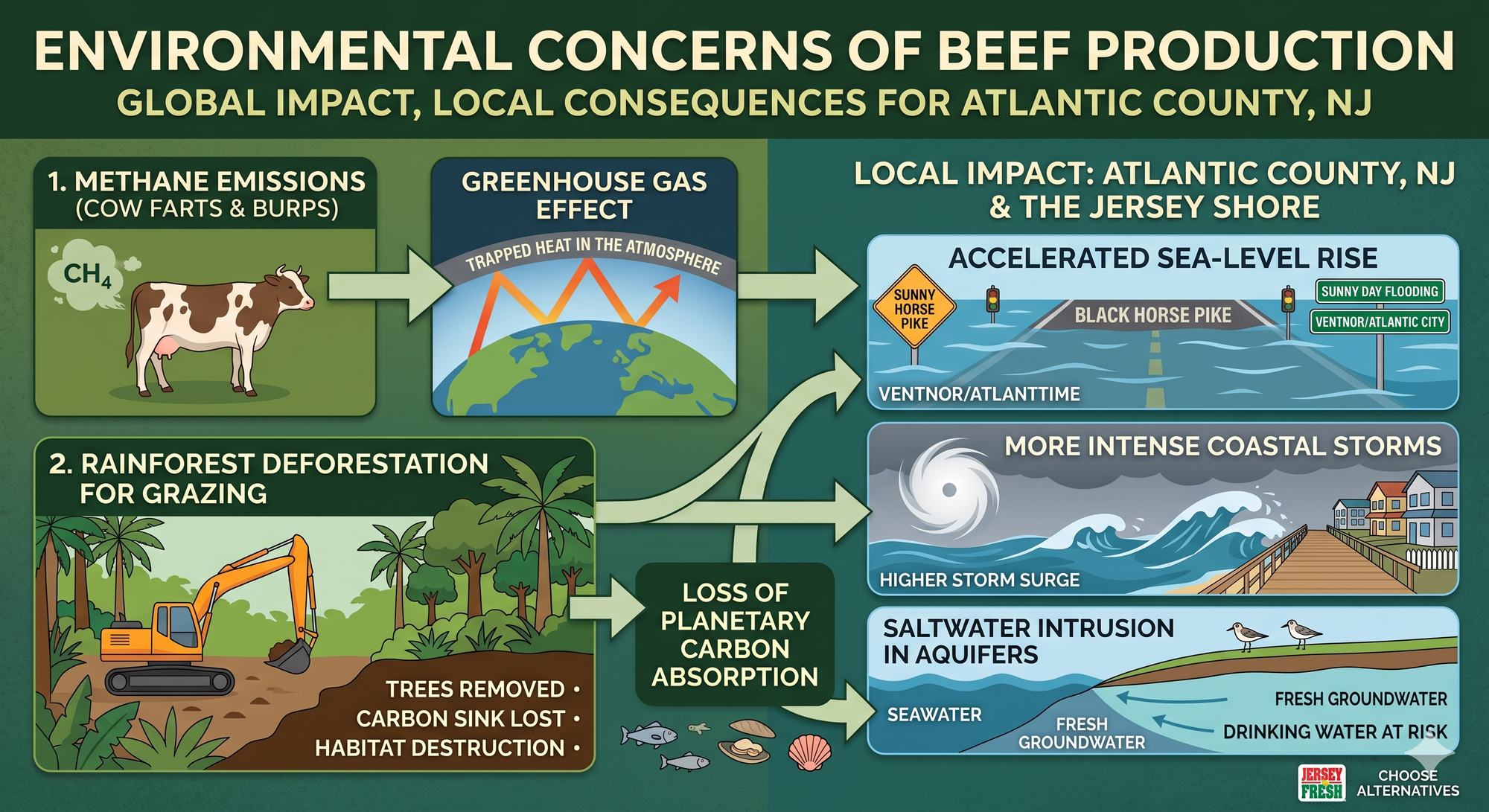
Let's talk about the elephant—or cow—in the room. Cows are ruminants, meaning they have a specialized digestive system that ferments grass. A byproduct of this is methane gas, which is released mostly through burping (and yes, some flatulence).
- Why it matters to AC: Methane is a "super-pollutant." It is roughly 80 times more effective at trapping heat in the atmosphere than CO2 over a 20-year period.
- The Local Link: Because methane accelerates global warming so rapidly, it speeds up the melting of polar ice. For Atlantic County, this translates to faster sea-level rise. When you see "sunny day flooding" on the Black Horse Pike or in Chelsea Heights, you’re seeing the long-term result of global methane emissions.
B. Deforestation: Trading Trees for Burgers
To meet the global demand for beef, massive swaths of the Amazon Rainforest are cleared every day to create grazing land for cattle or to grow soy for feed.
- The Carbon Sponge: Rainforests act as the planet's primary "carbon sink," sucking CO2 out of the air. When those trees are cut down, we lose that protection, and the stored carbon is released back into the atmosphere.
- The Local Link: As the global "sponge" disappears, the planet warms, and weather patterns become more volatile. For residents of Brigantine or Longport, this means more intense Nor’easters and hurricanes. Without the global forest canopy to regulate the climate, coastal towns are left more vulnerable to the "one-two punch" of rising seas and stronger storms.
C. The Global Water Loop
Beef production is a global drain on freshwater. When a massive amount of water is used to grow cattle feed in one part of the world, it affects the global water cycle.
- Saltwater Intrusion: As global temperatures rise (partially due to the beef industry), sea levels rise and push saltwater into our local freshwater aquifers.
- The Local Link: Atlantic County relies on the Kirkwood-Cohansey aquifer for drinking water. As we lose the "climate battle" globally, we risk saltwater contaminating our local wells. Choosing beef alternatives reduces the global pressure on these systems, helping to keep our local water fresh and drinkable.
2. Beating the "Searing" Beef Prices of 2026
If you’ve checked the meat aisle at the Egg Harbor Township ShopRite lately, you’ve likely felt the "sticker shock." As of early 2026, beef prices have surged nearly 15-20% due to tight cattle supplies.
In contrast, beef alternatives—especially whole-food options like lentils, black beans, walnuts, and pecans and Atlantic County-grown produce—remain much more stable.
- Budget Tip: Low-income seniors in Atlantic County can currently receive $40 credits for fresh produce at local farmers' markets through November 2026. This makes swapping a expensive beef burger for a "Jersey Fresh" veggie stack a massive win for your wallet.
3. A Healthier "Shore Bod" (and Heart)
We love our salt water taffy and boardwalk fries, but Atlantic County residents also face higher-than-average rates of heart-related health issues. Beef alternatives, particularly those made from whole plants, offer a nutritional profile that's hard to beat:
- Lower Saturated Fat: Swapping beef for a plant-based alternative can help lower LDL (bad) cholesterol.
- Higher Fiber: Unlike beef, alternatives like bean-based burgers are packed with fiber, keeping you full longer during those long summer days at the beach.
- Local Access: With places like Good Earth Organic Eatery nearby and the abundance of local farmers' markets in Pleasantville and Atlantic City, getting high-quality, heart-healthy alternatives has never been easier.
The Atlantic County Advantage:
Choosing a beef alternative doesn't mean sacrificing flavor. Between the "Umami" of mushrooms and the innovative plant-based menus appearing from Hammonton to Somers Point, you’re not just eating better—you’re eating like a local.
Ready to try a swap this weekend? Head to your nearest Atlantic County farmers' market and grab some local portobello mushrooms, for the grill. Your heart, your wallet, and the Jersey Shore will thank you!
Which local Atlantic County farmers' market is your favorite spot to find "Jersey Fresh" ingredients?
Thanks for reading the whole story!
At Atlantic City Focus, we're committed to providing a platform where the diverse voices of our community can be heard, respected, and celebrated. As an independent online news platform, we rely on a unique mix of affordable advertising and the support of readers like you to continue delivering quality, community journalism that matters. Please support the businesses and organizations that support us by clicking on their ads. And by making a tax deductible donation today, you become a catalyst for change helping to amplify the authentic voices that might otherwise go unheard. And every contribution is greatly appreciated. Join us in making a difference—one uplifting story at a time!